The term "fake news" has been used for many years in social media and in the news. A lot of people usually find it on different sources, such as Facebook, Twitter and YouTube. But it wasn't until 2016 when it began to impact the presidential election that it became more prevalent. Fake news will not stop any time soon. "Fake news stories have been around for as long as truthful ones," according to the article Fake news and the future of journalism. I do not know when it will go away, but what I do know is that it will influence people's opinions.
Last year, Pew Research Center and Elon University together did some academic and government research and asked one question which was "In the next decade, will public discourse online become more or less shaped by bad actors, harassment, trolls, and an overall tone of griping, distrust, and disgust?" The Future of Free Speech, Trolls, Anonymity and Fake News Online. The answers to this question were that "Some 39% of these respondents opted for the prediction that online activity would be more shaped by negative activities, while some 41% chose the option that they expect no major change in tone in online interaction."
Fake news doesn't seem like it is going to go away in the future. It might get even more popular within the next decade or so. Sometimes I like to read the news, but I usually stay away from news that is false. And that is a good thing for me because I always like to read news that is truthful.
Friday, April 7, 2017

Thursday, April 6, 2017
Looking at the Future for Fake News
The term "fake news" has been used for many years in the social media and news world. 44% of U.S. adults get their news from Facebook, 10% from Youtube, and 9% from Twitter, according to a poll done by Pew study in 2016 mentioned in the How Mark Zuckerberg Handles Fake News Will Determine The Future of Facebook article. It was not until couple years ago that it became even a bigger problem, especially during the election times this past year. Fake news will not go away any time soon. As much as some countries or websites can do to block "fake news", it will not be completely gone. It will interfere with people's freedom of speech.
Pew Research Center and Elon University asked 1,537 scholars and technology experts one huge question which was along the lines of " will public discourse online become more or less shaped by bad actors, harassment...." The Future of Free Speech, Trolls, Anonymity and Fake News Online. In response to the question, 42% said they expect no major changes in the coming decade and 39% said they expect the future to be more shaped by negative activities". As the article continues, it starts talking about freedom of speech in the online world. It says that people misuse that with harassing others and proving false news, which a lot of people end up believing. Although websites such as Facebook are trying to detect false news on their website, it can be controversial because how far can they go to tell someone to not post something until they come between the First Amendment.
Fake news does not seem like it is going away. It seems like it might even get bigger as the years go on. People now a days have strong opinions towards controversial issues such as gun control or abortion and they are driven by how many "likes" on Facebook they get or how many retweets on twitter they get. People will say just about anything in order to get some retweets. For example, an individual may post something about crime that happened but the individual did not get the right facts about it before posting it. Because of the post, it got others to retweet it and talk about it even though it is not even true. Twitter and Facebook are two of the biggest websites at the moment and news travels fast on those websites. The future for fake news is just beginning.
Pew Research Center and Elon University asked 1,537 scholars and technology experts one huge question which was along the lines of " will public discourse online become more or less shaped by bad actors, harassment...." The Future of Free Speech, Trolls, Anonymity and Fake News Online. In response to the question, 42% said they expect no major changes in the coming decade and 39% said they expect the future to be more shaped by negative activities". As the article continues, it starts talking about freedom of speech in the online world. It says that people misuse that with harassing others and proving false news, which a lot of people end up believing. Although websites such as Facebook are trying to detect false news on their website, it can be controversial because how far can they go to tell someone to not post something until they come between the First Amendment.
Fake news does not seem like it is going away. It seems like it might even get bigger as the years go on. People now a days have strong opinions towards controversial issues such as gun control or abortion and they are driven by how many "likes" on Facebook they get or how many retweets on twitter they get. People will say just about anything in order to get some retweets. For example, an individual may post something about crime that happened but the individual did not get the right facts about it before posting it. Because of the post, it got others to retweet it and talk about it even though it is not even true. Twitter and Facebook are two of the biggest websites at the moment and news travels fast on those websites. The future for fake news is just beginning.
Friday, March 24, 2017
Trolls in the Dungeon
Stories built upon half-truths or
outright lies are storming the United States by force. Angry people on all
sides are making claims against several issues including health care, taxes,
immigration, or foreign policies (to name a few).
While it is interesting to watch as
these issues are picked apart by the media and the American people, it is not
surprising to watch as the Internet trolls load up on their “fake news”
ammunition and petty insults to distract and redirect the average reader’s
attention.
There are endless examples of this
behavior throughout the Internet, and it is not limited to one side of an
argument. In many political articles, the comments are riddled with attacks on
the writer’s character or snips about another commenter’s mother. And people
with completely different world views, who align themselves with opposing
political parties, are all guilty of attacking their opponent’s character or
turning insults back onto their foes.
There seems to be a distinct attitude
within the comments of an article, and it can be very off putting for many
readers when these waves of hostility take over a place meant for discussion.
While it can be amusing on a surface
level to watch a bunch of volatile schmucks insult each other left and right, it
is obvious that there is no room for an actual discussion to grow. The comments
can quickly become a place where individuals with real concerns are afraid to
speak up because they do not wish to be publicly ridiculed.
Watching these verbally abusive brawls
unfold is rapidly becoming an everyday norm. But was this always the outcome of
online conversations? Were the actual concerns and issues that most citizens
without a voice in America could be drowned out and overshadowed by the
reckless and problematic arguments of the radical few?
Well, yeah. Of course! Negative seems
to strongly outweigh the positive when it comes to human nature.
Within the last week, the Republican
party has been pushing to pass their health bill in order to repeal and replace
the American Care Act (ACA) put into play during Barak Obama’s presidency.
Now, should one take a moment to peruse
the comment sections of most news sites that report on breaking news, such as
USAToday, The Washington Times, The Guardian, The Hill, or Fox News, a clearer
story can be sorted out.
Nearly every comment section has been
over-run by hostile and ugly insults or hate speech.
Below are a few gems that I found in, "Trump Blames the Democrats for GOP Health Care Bill Failure, Says ObamaCare is 'Imploding'," which focuses on the more recent topic of the GOP’s health care bill.


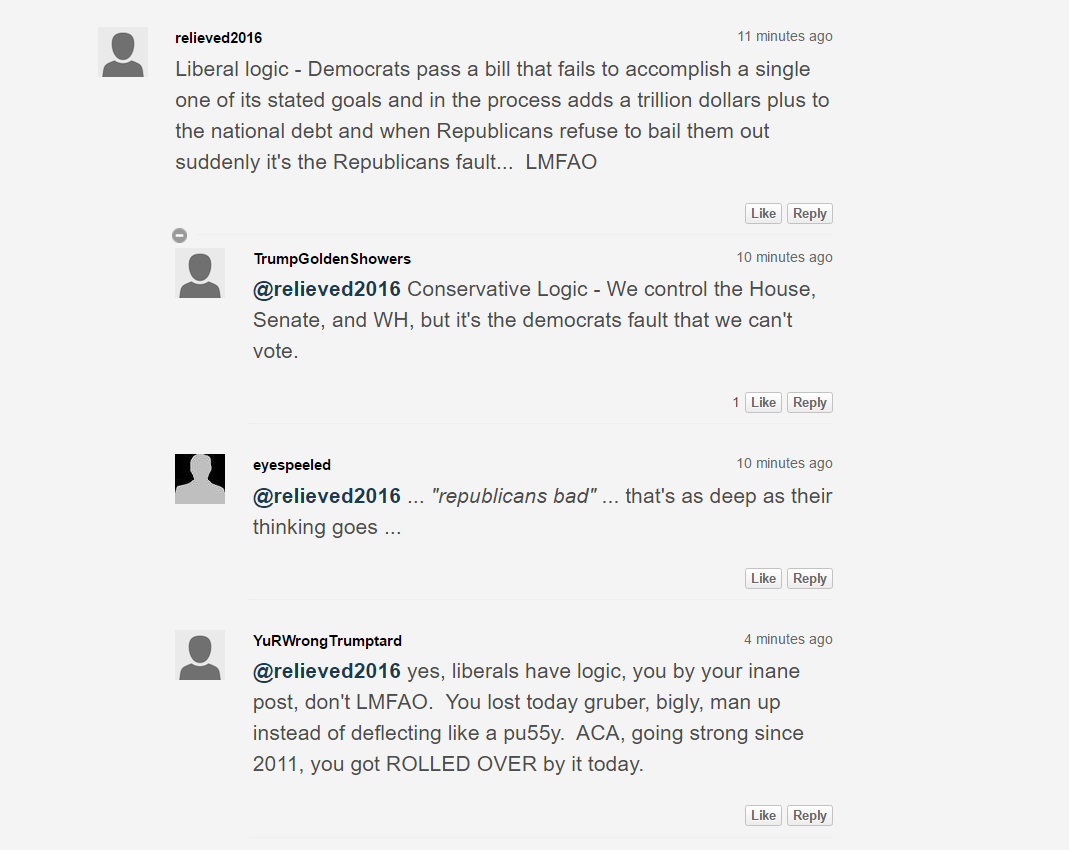


These insults against people’s
character and criticism against issues that are not dire or even being argued
tell a troubling story. Many people do not want to hear what they do not agree
with, and they are willing to insult their enemies (ad hominem) and turn ugly
comments thrown their way back onto their opponents (tu quoque.) This is not
the way respectable people should act.
And now, those who speak up in this era
are labeled as “easily offended” or “weak.”
“‘Poor Little Snowflake’ – the Defining Insult of 2016,” published by The Guardian, sums up the dynamic of people who
resort to insulting and blaming others who do not share their views. This
article looks at the term “snowflake,” which has been thrown around left and
right since the beginning of the US election, and focuses on how it has been
used as an insult.
Basically, anyone who disagrees with an
argument, or asks that offensive topics and reasoning be questioned and
rebuked, are deemed “thin-skinned and weak minded.”
The author of this article, Rebecca
Nicholson, writes:
So if the right are calling the left snowflakes for being
liberal, and the left are calling the right snowflakes for expressing offence,
and the old are calling the young snowflakes for being too thin-skinned, and
the young are pointing out that the older generation seem to be the most
offended by what they’re doing, then the only winner is the phrase itself.
Her words tell a story that there is no
sure way to win these arguments, but her observations should serve as a wake-up
call. Do not take the comments personally. Instead, participate in local
politics, keep yourself updated on breaking news from multiple websites – even
websites with views that do not share your exact values – and do not let the
comments get you down.
Staying well informed is a great way to
stand above the rioting crowds, and it is also a great contribution to the
cleanup of the Internet comment sections. If there are not enough rude and
angry people in the comments, the discussions will eventually die out.
Keep on keeping on and please, don’t
feed the trolls.
Logical Fallacies in Fake News
A logical fallacy is an error made in terms of reasoning. Fortunately fallacies can be identified from the lack of evidence that's supposed to back up the other person's claim(s).

A good example is Alex Jones (a conservative radio show host) who often discusses conspiracy theories and news on his radio show (as well as his website) called InfoWars. The problem is that his news is filled with logical fallacies, such as the Slippery Slope (also known as The Camel's Nose fallacy) and the "No True Scotsman" fallacy.
Jones shared his views about the Pizzagate incident back in December, and not only was it fake news with a bunch of unreliable "evidence" (as far as the FBI obtaining "secret codes" that are used by pedophiles when trafficking children), but he even started off with an irrelevant topic in the video.

A good example is Alex Jones (a conservative radio show host) who often discusses conspiracy theories and news on his radio show (as well as his website) called InfoWars. The problem is that his news is filled with logical fallacies, such as the Slippery Slope (also known as The Camel's Nose fallacy) and the "No True Scotsman" fallacy.
Jones shared his views about the Pizzagate incident back in December, and not only was it fake news with a bunch of unreliable "evidence" (as far as the FBI obtaining "secret codes" that are used by pedophiles when trafficking children), but he even started off with an irrelevant topic in the video.
Logical Fallacy In Fake News

The topic of fake news has been a rather controversial topic these past years. This is partially due to the recent presidential election. The election brought up a lot of articles that had no truth value, but people would believe it anyways. Why would this be? Due to the fact that it's what they want to believe. If it helps their point they are trying to make then they will believe it and use it against others.
Much fake news is written with many logical fallacies connected to them. A logical fallacy as defined by Purdue OWL "is common errors in reasoning that will undermine the logic of your argument". The 3 common fallacies are Ad hominem, the attacking of a person rather than their argument, hasty evidence, making your own conclusion based on bias opinion, and genetic fallacy, where a person or idea's origins define what it is. Fallacies show up in arguments to make it seem believable to the point that it influences others to believe it.
Many journalists believe that during this presidential election ad hominem was overused. Each candidate attacked the other in whatever way possible in order to win the presidency. This election has shown a high in politic awareness. Even though the cause of this awareness is due to the fake articles and headline that people have read.
Logical fallacies have been apart of news posts since the printing press was invented. It has increasingly become more of a problem while being connected to fake news, and has started to turn people against each other. It has caused the loss of friends and family around the world.
Fallacies In News
Logical fallacies are flaws in reasoning. You see this on many occasions. A lot of politicians use this to try and undermine their opponent. When trying to make a good point or argument, one must have facts and truth behind what they are talking about. People tend to use the "if this occurs, then this will happen" theory. This was the case when the republicans said that Obamacare would fail if this and that, instead of giving facts on why it wasn't the best idea. Many people tend not to stick with the issue, but say thing that are very irrelevant to the topic.
Just as well as they do it in politics, they use it in plenty of other media sources. They use it in the comments of news and even sports. People bashing one another using fallacies. They make arguments towards each other that has nothing to do with the issue. I read a sports report on Kobe Bryant and why he might be the greatest of all time which was of course the authors opinion. But instead of focusing on basketball and facts on why he wasn't, people in the comments were bringing up his 2004 rape charges that had nothing to do with basketball.

Ad Hominem Fallacy is used way to much in politics as we seen this year. The whole police election felt as if the candidates were trying more to tear their opponent down then stick to the facts ad issues at hand. I also read a story on a author who wrote about the War against ISIS. The story to me had plenty of facts and had reliable sources. But I seen in the comments people bashing this author. Someone said how can we believe this guy who isn't married with kids. The very point of that had no fact but instead basing his view on his personal life.
After all we live in a world where Logical fallacies are used in many different scenarios. People bring up things that have nothing to do with the argument and for that I don't have an answer. The media plays the biggest role in giving people their opinion. Social media lets them speak behind a keyboard on any discussion they want to join. Most of the comments you will read will be biased or have no reasoning behind an argument.
Just as well as they do it in politics, they use it in plenty of other media sources. They use it in the comments of news and even sports. People bashing one another using fallacies. They make arguments towards each other that has nothing to do with the issue. I read a sports report on Kobe Bryant and why he might be the greatest of all time which was of course the authors opinion. But instead of focusing on basketball and facts on why he wasn't, people in the comments were bringing up his 2004 rape charges that had nothing to do with basketball.

Ad Hominem Fallacy is used way to much in politics as we seen this year. The whole police election felt as if the candidates were trying more to tear their opponent down then stick to the facts ad issues at hand. I also read a story on a author who wrote about the War against ISIS. The story to me had plenty of facts and had reliable sources. But I seen in the comments people bashing this author. Someone said how can we believe this guy who isn't married with kids. The very point of that had no fact but instead basing his view on his personal life.
After all we live in a world where Logical fallacies are used in many different scenarios. People bring up things that have nothing to do with the argument and for that I don't have an answer. The media plays the biggest role in giving people their opinion. Social media lets them speak behind a keyboard on any discussion they want to join. Most of the comments you will read will be biased or have no reasoning behind an argument.
Logical Fallacies in News
When it comes to news and politics, most of what you hear during the elections and debates are the competitors attacking each other to get their point across. This is called "Ad Hominem", a logical fallacy that means attacking an opponent's character or personal traits in order to invalidate their arguments. What is a logical fallacy, you ask? Logical fallacies are "errors in reasoning that render an argument invalid."
Why do peoples logical fallacies? That is a question that will probably never have an answer. All i can say is, when people feel as if they are being attacked, they get defensive and attack back. These fallacies will always be used in politics and sometimes even entertainment.
There are many examples in the news where ad hominem comes into play. This article on President Trump from USA Today is one them. During the campaign, Trump pretty much always let his opinions known about his opponent, Clinton's, character.
Ad hominem is not the only logical fallacy you see in the news and politics. When someone answers a criticism with criticism, it is called the "Tu Quoque" fallacy. This fallacy can also be found in the news, but of course mostly in politics. It is more specific than ad hominem, therefore harder to find. However, an article on Forbes' website provides a perfect example.
Although the article is an opinion article, it still sums up tu qouque in an interesting way. It says,
"It is entirely true that "tu quoque" is a logical fallacy, it being a specific case of the ad hominem one. The truth or not of something is not dependent upon who says it nor either what they've said nor how they've acted in the past. Yet while it's a logical error, in that it doesn't invalidate the argument being put forward, it's still a very useful technique. For if "you do it too" is indeed a truth then we can weigh what it is that we're being told to do more carefully."This is a good way, I believe, to put the fallacy in perspective.
Why do peoples logical fallacies? That is a question that will probably never have an answer. All i can say is, when people feel as if they are being attacked, they get defensive and attack back. These fallacies will always be used in politics and sometimes even entertainment.
Subscribe to:
Posts (Atom)